The City as Technology
Or: What Happens When You Leave Your AI City and Spend a Few Days In an Art City

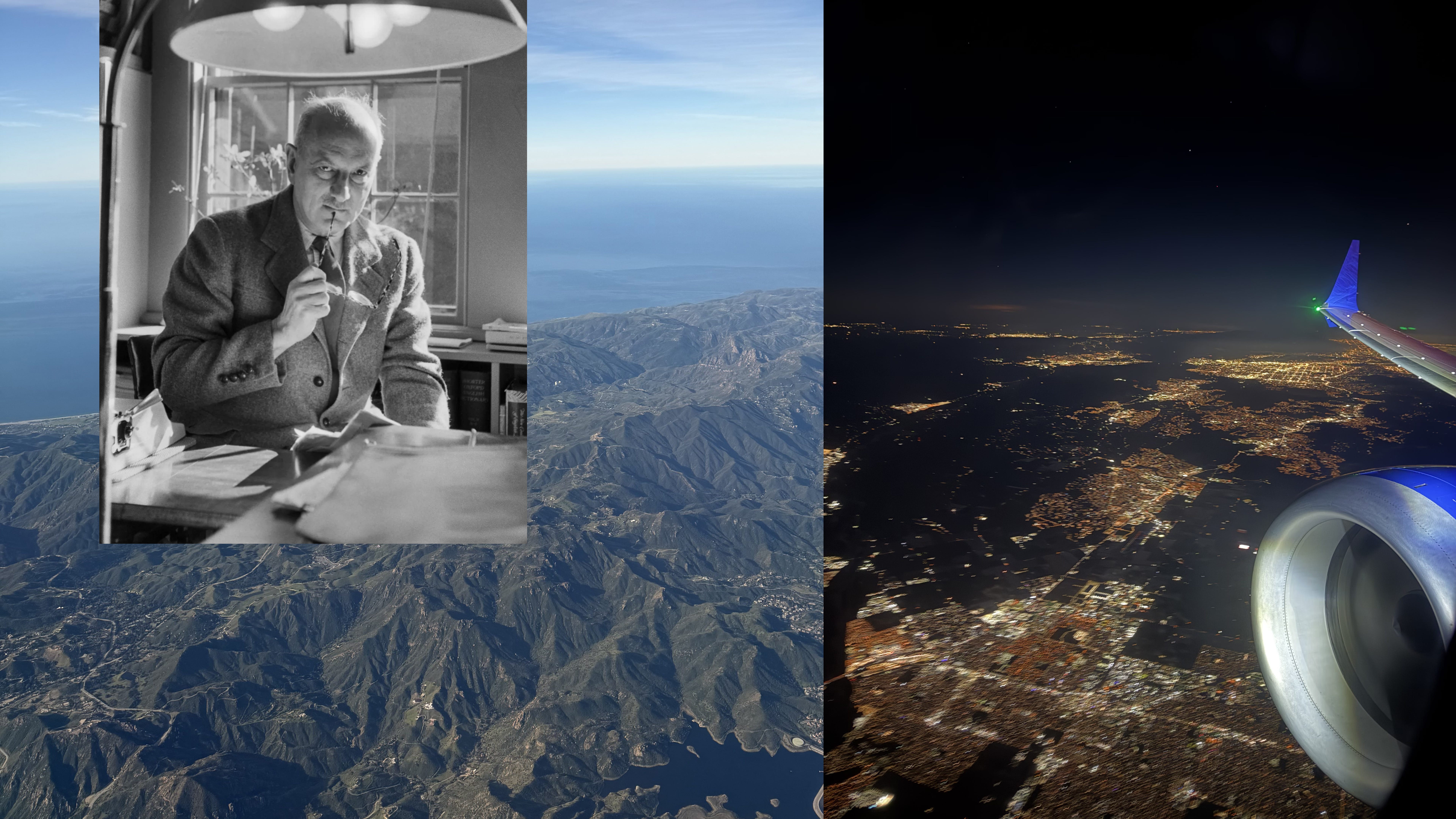
“The city is a fact in nature, like a cave, a run of mackerel or an ant-heap. But it is also a conscious work of art, and it holds within its communal framework many simpler and more personal forms of art. Mind takes form in the city; and in turn, urban forms condition mind.”
— Lewis Mumford, The Culture of Cities, 1938
/
I flew down to Los Angeles a few weekends ago in need of something else.
I work in AI. I live in San Francisco — a city whose founding mythology is disruption, whose dominant currency is scale, whose dinner table conversation is, often, AI. The city selects for a particular kind of intelligence: technical, systems-level, relentlessly future-oriented. I love it. But also in need of leaving it behind for a few days from time to time.
What I was going to do in Los Angeles was bathe myself in art. That’s really all I had in mind. A few days, a few friends, a heat wave, and art fairs. I didn’t expect it to change how I think about what I’m building.
/
Mumford wrote that opening line in 1938, but I am returning to it now, in 2026, because what I just experienced is what he described. We talk about intelligence systems — the large language models and reasoning engines that are reorganizing enormous amounts of human work — as if they emerged almost by accident. But they didn’t. They emerged from cities. From the density of research institutions, capital, talent, distinct thinking, and competitive pressure that only certain places in the world produce in sufficient concentration. The intelligence didn’t precede the city. The city produced the conditions for the intelligence.
Which sounds a lot like what Mumford was describing.
A city is not simply an aggregation of people. It is something that emerges from density and produces capacities that couldn’t exist in dispersed form. The urban concentration doesn’t just gather existing things together — it transforms them into something new. Something that couldn’t have existed otherwise.
That is also, more or less, what people now say about intelligence itself. That it is not a property of any single neuron, or any single parameter in a neural network, but something that emerges from density and connection at sufficient scale. A property of the system, not its parts.
San Francisco is a particular intelligence. Los Angeles is another.
/
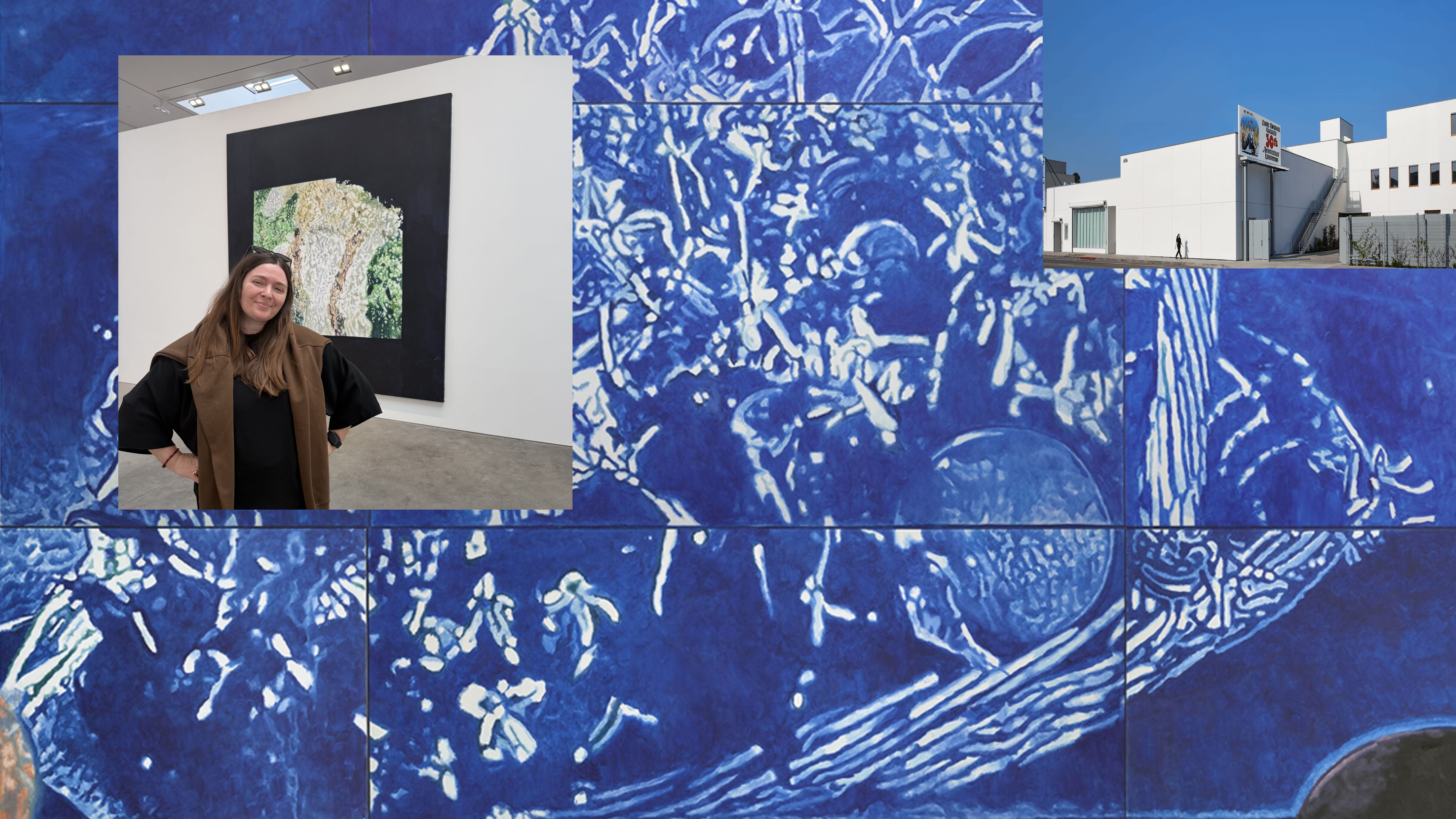
After landing at LAX at 9 AM on a Friday, I went to Karen’s (Gaskill). She had recently been pulled to LA from New York to work more closely with Google — she has a PhD in Digital Curation and is the executive producer for immersive and experiential work for spatial content partnerships across Google XR, 100 ZEROS, and Gen AI (DeepMind). All that is to say she is thinking about how digital media interplays with emerging immersive technologies, so I was not surprised she has ended up in Tinseltown.
I shaved my legs, put on some shorts (it’s 85 degrees already), and we embarked on our first stop — David Zwirner on the edge of Melrose Hill, where Luc Tuymans has a show called The Fruit Basket in a building designed by Annabelle Selldorf. Selldorf, whose architecture I’d been vaguely aware of but had never experienced firsthand, does something unexpected: she steps back. The architecture serves the art by refusing to compete with it. Neutral walls, precise light, high ceilings that make room for the work to breathe. The space itself disappears — and in that disappearance, you’re left with nowhere to look but at the thing you came to see.
We went to David Zwirner not just to see the art, but to see my friend Lia Trinka-Browner, who moved to LA twenty years ago for graduate school at ArtCenter College of Design to study Art Theory and Criticism. The city drew her a long time ago. She and I went to high school together in Fayetteville, Arkansas — I think we may have taken a field trip to Little Rock in 1999, photographed things I can’t remember. The layering of time in that room felt appropriate. Past and present sitting together, just barely in frame.
Tuymans’s paintings are deceptively still. Muted, almost washed out, everything slightly off — the color not quite right, the figures not quite present. The three of us stood in front of them in something like awe, calling out what we saw. Subtle references to images — cyanotype, phone screen at night, thumb print at the corner, faded idea of a family. He’s painting memory. Approximation. The way things are present to us when they are partly gone. There’s a particular kind of reaching in an image that almost coheres.
/
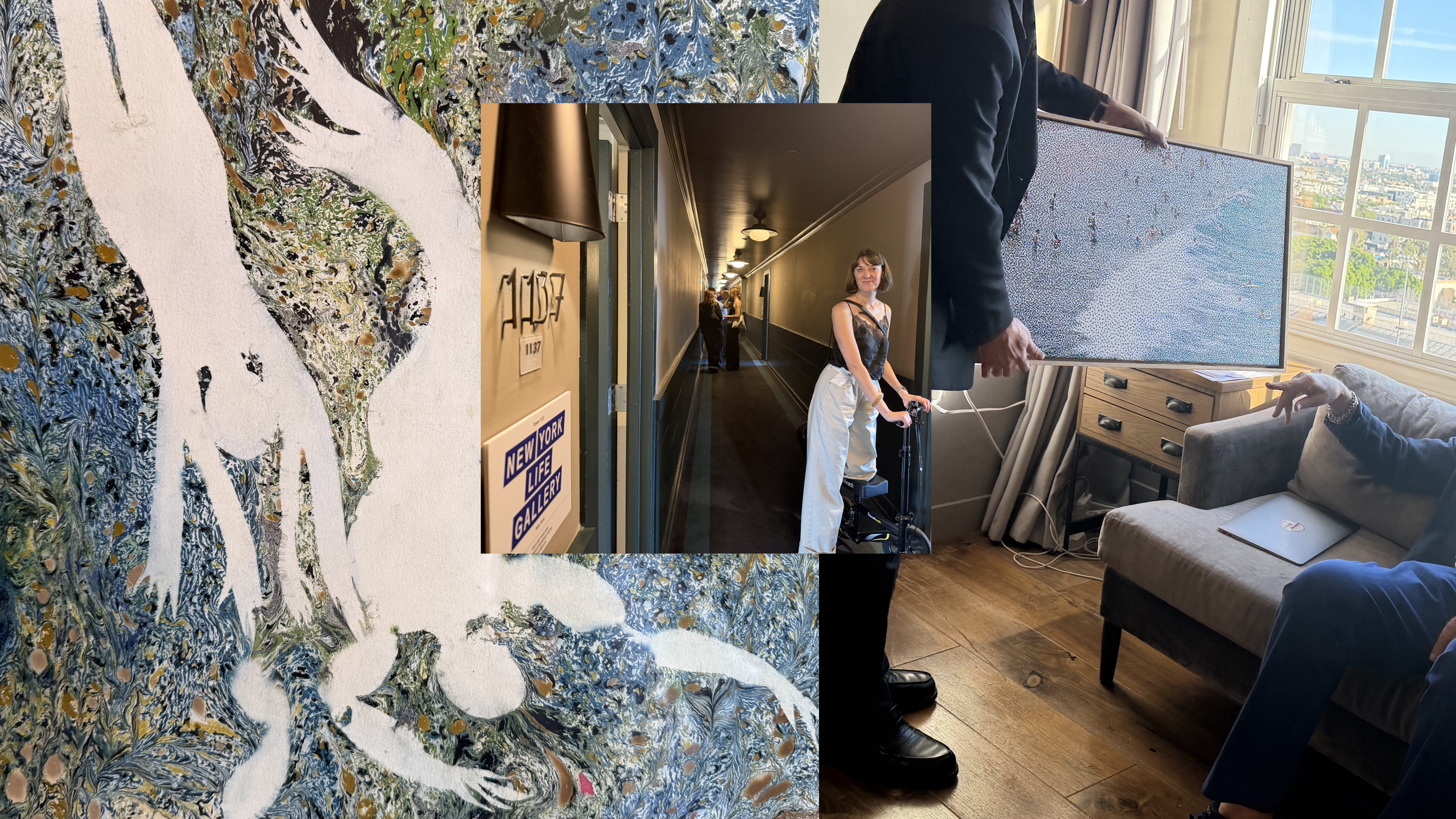
The Felix Art Fair lives inside the Roosevelt Hotel. This is, architecturally, the opposite of Selldorf: the art is inserted into pre-existing rooms — hotel rooms, corridors, a courtyard — rather than housed in space designed for it. The intimacy is forced. You overlap with strangers. You run into the same people across different rooms, building an accidental familiarity that a traditional fair can’t create.
Melissa Huddleston, represented by Luis De Jesus Gallery, makes work that holds a particular tension between surface and depth — something that reads as archival practice and fairytale fun. And Thomas Andréa Barbey, with Sobering Galerie, does something stranger: images that seem to belong to a history that didn’t happen, documentation of something muted and fuzzy. In the scale of a hotel room, both felt almost too close. Which might be exactly the right distance.
There’s something about art in intimate space that makes you aware of other people’s experience of it. At the Roosevelt, we heard people talking about pieces they wanted to bring home — what it would mean next to the couch, in the hallway, facing the bed. The decision to bring an object into a domestic space is a decision about what you want your interior life to look like. How you want to be conditioned by your surroundings. I found this unexpectedly moving. It’s a question I don’t ask myself often enough.
/
The last stop of the first day was the one that was most unexpected.
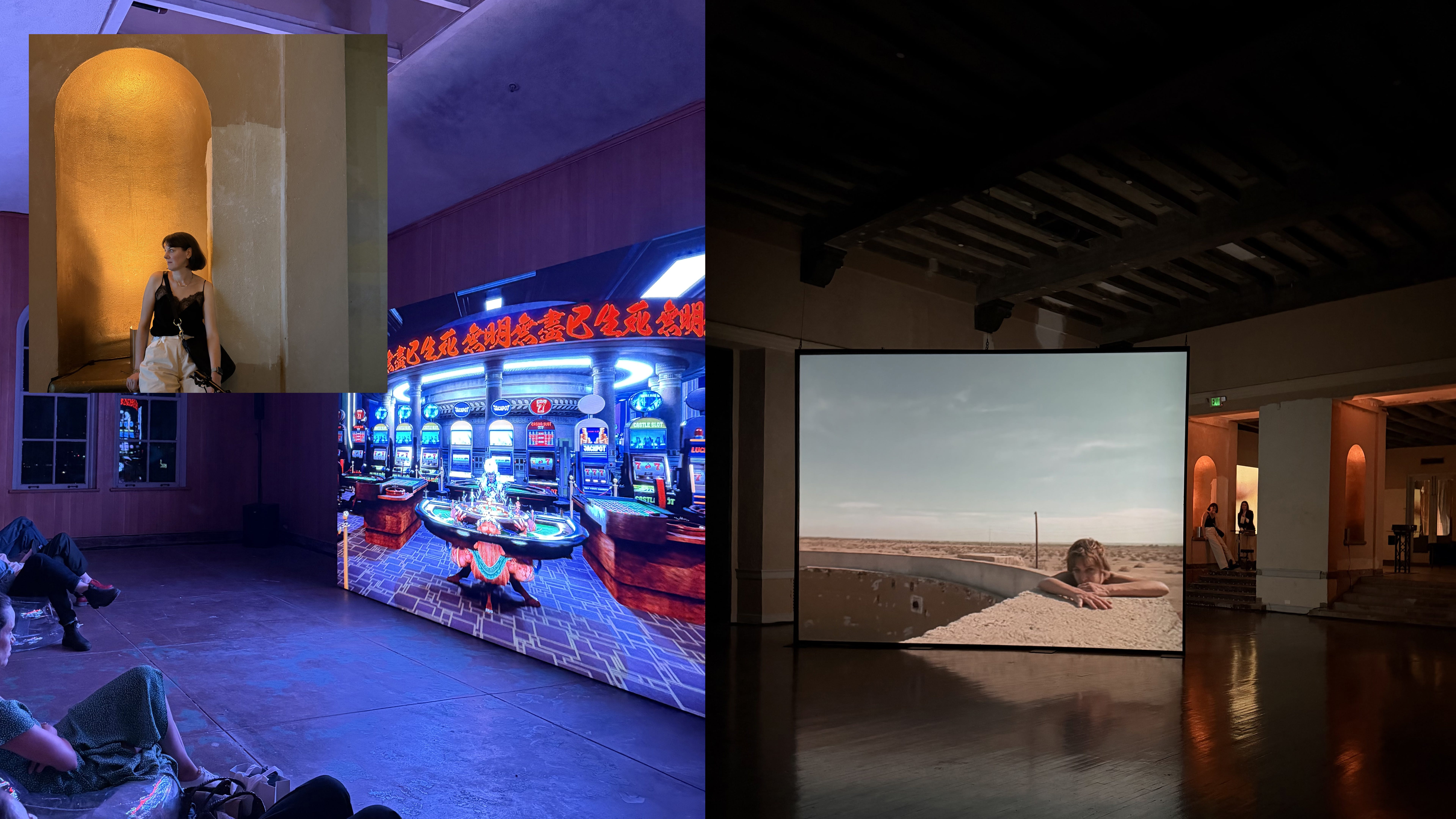
Julia Stoschek organized What a Wonderful World: An Audiovisual Poem inside the Variety Arts Theater — a five-story Venetian-style building in downtown Los Angeles that has spent much of its life vacant, an occasional venue for raves, essentially given over to time. They’d done just enough to make it pass fire code — not finished, not restored, left partially in its state of becoming-ruin — and then filled every floor, every alcove, every dark corridor with the moving image.
We started at the top and worked down. Fifth floor: first photographs of motion. A kangaroo boxing. A rocket to the moon. But also Doku the Flow.
I don’t know what else to say about Lu Yang’s Doku the Flow except that I am still thinking about it. What I didn’t know at the time — and learned later — is that as otherworldly as it looks, it isn’t AI-generated. Lu Yang spent years amassing an enormous personal library of imagery, video, and sound, accumulating it the way a composer accumulates musical vocabulary, and assembled this hour-long work from that archive. The density of it — Buddhist iconography, video game aesthetics, layers of cultural logic that should not connect and somehow do — is the product of human duration, not machine synthesis. It only looks like something a model dreamed. That confusion felt important to sit with. (Lu Yang has since begun experimenting with AI-generated work; I haven’t seen it and can’t speak to it. I’m curious what that practice looks like from someone who built their aesthetic vocabulary so deliberately by hand.)
Doug Aitken’s Blow Debris (2000) was there too — naked bodies drifting through the Mojave, landscapes replacing narrative, aimless wandering. I watched it for a long time, thinking about what happens when meaning is made at the edge of legibility.
We spent three hours there. We probably could have stayed longer. Somehow the installation was free. At some point Karen and I looked at each other and just laughed — at the absurdity of it, the generosity of it, the fact that this was happening at all.
Stoschek’s money comes, in part, from her family’s history of manufacturing war materials in Nazi Germany. She doesn’t hide this. The show itself grapples with it: war, violence, the slow reckoning of inherited complicity. I haven’t seen any collector sit so directly inside that particular discomfort. I don’t know if it’s the right way to reckon with that history. I’m not sure there is a right way. But I found myself moved by the refusal to look away from the origin of the thing. Knowing more war lay ahead of us all.
/
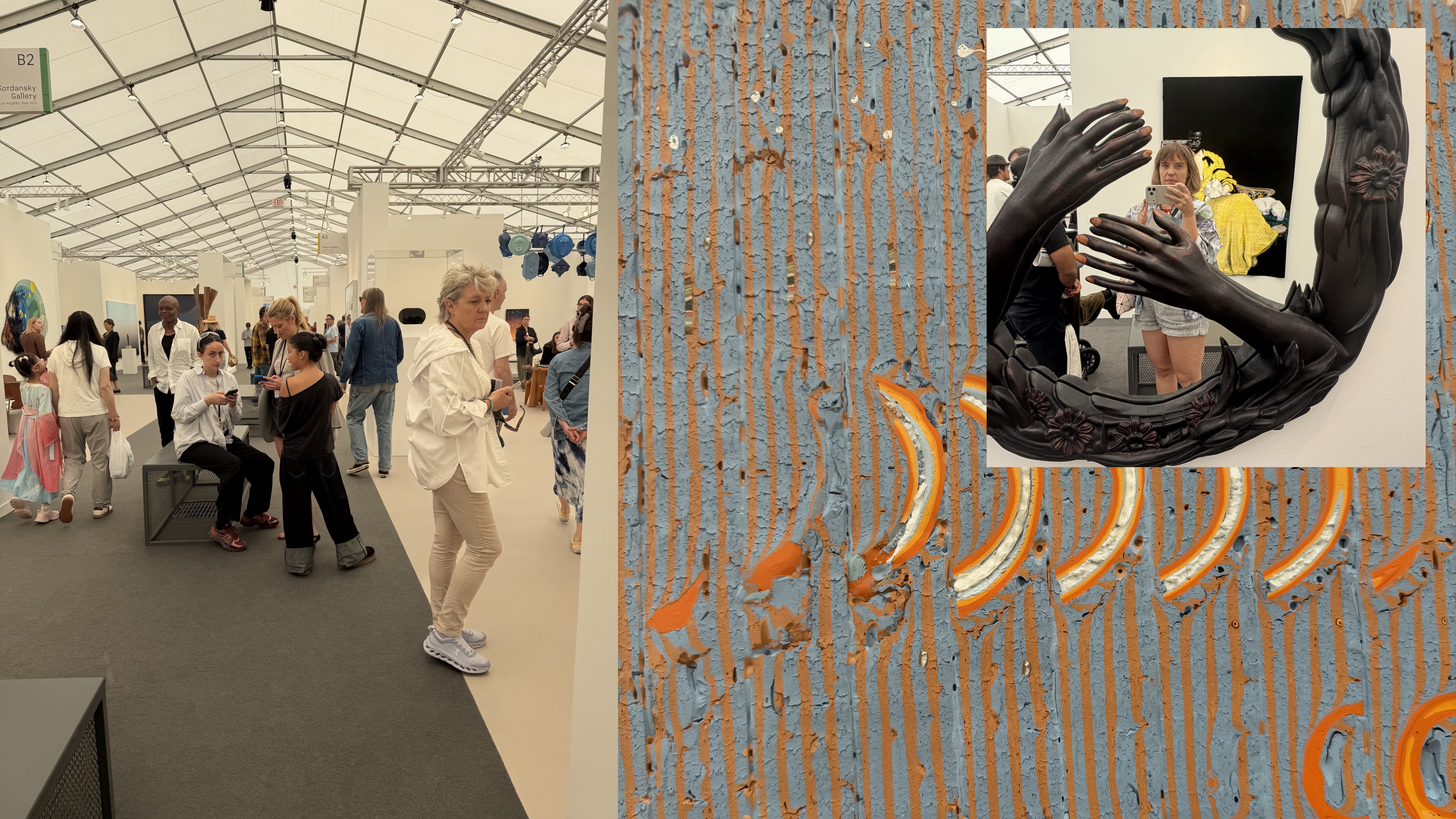
The second day was Frieze, in an airplane hangar in Santa Monica — the traditional art fair format, a market organized like a market, stalls and galleries and the particular electricity of things that are for sale.
Anish Kapoor’s work was there. Non-Object Black (2021–22), in Vantablack — the material that absorbs 99.965% of light, the darkest substance ever manufactured — is an object you cannot fully see. There is form there, you can sense the edges of it, but the surface refuses to give you back the information you’re accustomed to receiving. Looking at it is like looking at a hole in the world. Your visual system keeps reaching for detail and finding nothing. The refusal is total. It feels like an absence that has weight.
I also became captivated by Loriel Beltrán’s Dusk or Smog (Foam Lexicon) (2025) — a piece made from industrial foam that accumulates into a field of gradation. Beltrán’s work sits at the border between synthetic and organic in a way that is increasingly hard to locate. It doesn’t announce its materiality; it lets you discover it. The discovery is the point.
/
What happens when you spend a few days just looking at really good art?
I felt connected to humans. A relaxed awareness opened to whatever the artists were painstakingly trying to convey. Not relaxation, exactly — more like a recalibration of where my attention usually lives versus where it can live.
Here is what I also could not ignore: none of this was AI. None of the art seemed to even give it a nod. And that feels worth noting. I asked Karen and Lia if they had seen anything interesting happening with AI in the art world and they said no — nothing worth mentioning. Maybe that will change. But the work at every venue this weekend was made by people in relationship with physical materials over time, through labor that accumulated into something the process couldn’t fully anticipate. Tuymans’s washed-out approximations. The geological foam of Beltrán. Kapoor’s machine-specific blackness, years of seeking a particular absence. The hand is present in all of it — not always literally, but as evidence of sustained attention, of a relationship between a person and a medium that can only be built through duration.
And then there’s Doku the Flow — which looks like it could have been generated but wasn’t, which is the kind of distinction that used to be easy to make and is now increasingly not. I don’t know if that boundary will hold. I suspect Lu Yang is already testing its edges. But standing in that theater, at ten o’clock at night, looking at something built from years of human accumulation — I wasn’t thinking about prompts at all.
Large language models — and I work with them, think through them, build things with them every day — are human language compressed. The pattern-recognition of billions of words, distilled into probability weights. This is extraordinary. It is also entirely dependent on there having been humans who used language to capture experience, to reach for the things that couldn’t quite be said, to make felt sense of living. The AI requires, as its substrate, the prior existence of all of this.
Art is doing something different. Not capturing what can be said. Deliberately going after what can’t. The thing that falls outside language, outside instruction, outside any framework you could write down and hand to a reasoning engine to follow. Tuymans is painting the gap between memory and experience. Lu Yang is building a cosmology that you have to feel your way through. Kapoor is making a material absence that takes up space.
These are not things you can prompt.
/
Mumford also wrote that “the chief function of the city is to convert power into form, energy into culture, dead matter into the living symbols of art.” I think we are in a moment when that conversion is being asked to happen at unprecedented speed, with unprecedented tools, and many of us who work close to the technology are struggling to stay in contact with what we’re converting and why.
I needed to go to LA. I needed to spend two days in a heat wave, walking between gallery spaces with Lia and Karen — two people who were pulled to this city for its particular creative intelligence — looking at things made by hand over time, made to reach for what language cannot reach for. I needed to be in the Variety Arts Theater at ten o’clock at night, looking at Lu Yang’s cosmology, peering into a world I had not been aware of.
I came back Saturday at 9 PM. Fuller. Better suited to having alternative perspectives revealed to me. Richer in whatever the word is for feeling more connected to other humans across time — from the person who first pointed a camera at a boxing kangaroo and decided that was worth capturing, to Anish Kapoor in his studio, working for years toward a specific black. To my high school friend and her very distinct laugh, unchanged across twenty years.
The city produces intelligences that couldn’t exist elsewhere. Los Angeles produced an intelligence I needed: the intelligence of image and narrative and form, of creativity that insists on the primacy of human experience precisely because human experience is increasingly, urgently, the thing we need to stay in contact with.
Mind takes form in the city. The city, in turn, conditions mind.
I’m still being conditioned by the one I visited. I hope it takes a while.
This article was written in collaboration with Claude using writing style instructions I developed by analyzing my previous work. Read full process here.
Graphic collage inspiration: Laura Cassidy from Grievers Ball.